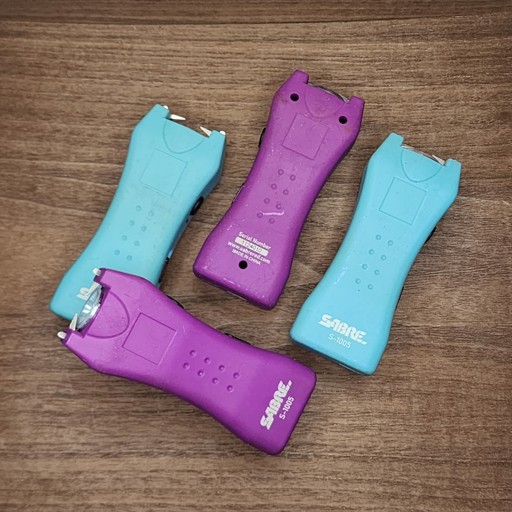
How stun guns work
Stun guns work by delivering a high-voltage, low amperage (a.k.a. “amp” – the unit of electric current) on contact, delivering a series of effects, such as pain, muscle disruption, and disorientation, momentarily incapacitating them so the user can get away. The full impact of stun gun use depends on where the charge lands and its duration.
Stun gun effectiveness
Stun guns work best at close range, where firm contact is maintained for several seconds. Many factors determine its effectiveness, including the attacker’s size, clothing thickness and user readiness. When used correctly, they can be incredibly effective at stopping a would-be attacker.
Stun guns are a non-lethal self-defense device, designed to create an opportunity to escape to safety.
SABRE top pick: 2-in-1 stun gun with flashlight and anti-grab bar technology; Featuring a 1.250 µC (microcoulombs) charge, this stun gun produces intolerable pain according to the National Institute of Justice. The Anti-Grab Bar shocks an attacker if they try to take the unit away from you, helping the user maintain control of the stun gun.
Stun guns versus other personal safety devices
Stun guns versus pepper spray
Pepper spray and pepper gel are effective deterrents against threats and provide protection at a distance. The primary ingredient in both is oleoresin capsicum (OC), a compound derived from hot peppers that causes intense burning. (Read SABRE’s Complete Guide to Pepper Spray and Pepper Gel Explained) While pepper spray and pepper gel can be used at a distance and against multiple attackers, a stun gun is only effective in close-range situations.
Stun gun advantages
Stun guns are non-lethal, compact, reusable and often equipped with flashlights or alarms. A benefit to carrying a stun gun is the loud and intimidating crackling sound at startup, which can act as a deterrent before contact is required. These devices are also a great option when a threat is up close.